Voice of the Customer
Building systems for representative feedback and sustainable recruiting
The Voice of the Customer isn’t a report or a meeting—it’s a system. It’s how customer feedback flows into your organization, gets documented, synthesized, and ultimately shapes what you build.
Without a system, customer feedback is noise. With a system, it becomes signal. The difference between product teams that build what customers want and those that build what they assume customers want often comes down to how well they’ve designed this flow.
Customer Segmentation & Representation
Understanding Who You’re Hearing From
Not all feedback is equal, and not all users are the same. Before you can ensure representative feedback, you need to understand who your users are and which segments matter most for different decisions.
Build cohort understanding into your product if possible. If you can identify what type of user someone is—their industry, role, lifecycle stage, usage patterns—you can filter and segment feedback automatically. This lets you answer questions like “What do power users think about this?” or “Are new users struggling with onboarding?”
If you can’t build this into the product, track it through other means:
- Survey existing users to understand their demographics and context
- Track the demographics of your interview participants
- Look for patterns in who you’re hearing from vs. who you’re not
Evaluate patterns for where you should test more. If 80% of your interviews are with power users in one industry, you’re likely missing perspectives from new users, churned users, or adjacent markets. The tracking itself reveals blind spots.
Who to Talk To
Different user segments reveal different things:
| Segment | What They Reveal | When to Prioritize |
|---|---|---|
| Power users | Advanced workflows, edge cases, feature depth | Optimizing existing features |
| New users | Onboarding friction, first impressions, learning curve | Improving activation |
| Churned users | Why people leave, unmet expectations, competitive gaps | Retention problems |
| Prospects who didn’t convert | Barriers to adoption, competitive positioning | Growth challenges |
| Different industries/roles | Varied use cases, terminology differences | Expansion opportunities |
| Customer-facing teams | Common questions, workarounds, support patterns | Quick signal on issues |
Once per quarter, deliberately reach out to each major audience. This prevents you from over-indexing on whoever is easiest to reach.
Depth vs. Breadth
There’s a tension between talking to the same customers repeatedly (depth) and talking to diverse customers (breadth).
Depth advantages:
- You understand their context deeply
- You can see how their needs change over time
- They become comfortable sharing candid feedback
- You catch nuances that one-time conversations miss
Breadth advantages:
- Fresh perspectives not influenced by your current product
- Avoid designing for too narrow a market
- Catch blind spots from over-familiarity
- Discover adjacent use cases and markets
The solution: do both deliberately.
- Maintain an advisory board for depth (same customers over time)
- Periodically recruit fresh participants through external tools
- Refresh your advisory board members over time—cycle people in and out
- Use tools like UserInterviews or similar to find people in your demographic who haven’t used your product
You want users to stick around long enough that you understand their context, but not so long that you think their perspective is all there is.
Recruiting Infrastructure
The Recruiting Reality
Recruiting is often the bottleneck that kills continuous discovery. Teams know they should talk to customers weekly, but finding those customers takes time they don’t have.
It’s better to have too narrow a group of real testers than no testers at all. Don’t let perfect be the enemy of good. Start with whoever you can reach, then expand over time.
Recruiting Methods by Situation
| Method | Best For | How It Works |
|---|---|---|
| In-app widget | High-traffic products | ”Do you have 20 minutes to talk about your experience in exchange for $20?” Links to calendar. |
| Piggybacking on client meetings | B2B products | Ask customer-facing colleagues to let you join for 5 minutes at end of their calls. Build relationships over time. |
| Surveys with opt-in | Existing customers | Include “Would you be willing to talk to us?” at end of surveys. Creates warm leads. |
| Online recruitment tools | Fresh perspectives | UserInterviews, Respondent, etc. Find people in your demographic who haven’t used your product. |
| Landing page recruitment | New products | Drive traffic to landing page, recruit directly from signups. |
| Feedback forums | Consumer products with engaged users | Tools like Canny give users a place to submit and vote on ideas. |
| Trigger-based outreach | Specific behaviors | When customer cancels, asks about feature X, or requests customization—trigger interview request. |
Online recruitment tools are most helpful for fresh eyes. These give you access to people in your target demographic who aren’t already influenced by your current product. The tools have gotten much better and can significantly reduce recruiting burden.
Piggybacking works well for B2B relationship building. Ask customer success or sales if you can join the last five minutes of their calls. Make it easy for them to say yes—don’t ask them to do extra work.
Who Owns Recruiting?
At small companies, PMs usually carry the load. There’s no way around it. You need customer contact, and you’re the one who needs to make it happen.
As you grow, UXR can help share the load. But even then, PMs should stay close to customers—not outsource all customer contact to researchers.
Building an advisory board helps reduce ongoing recruiting burden. Once you have a stable group of recurring participants, you’re not starting from zero every week.
Making It Sustainable
The goal is one interview per week per key user group. This is achievable if you:
- Build recruiting into your systems (in-app prompts, triggered outreach)
- Maintain an advisory board that you can tap regularly
- Share recruiting across the team (everyone trained on recruiting and interviewing)
- Use external tools when you need fresh perspectives
Advisory Boards & Ongoing Relationships
When to Build an Advisory Board
Advisory boards make sense when:
- Your market is hard to reach or small
- You need deep context that develops over time
- Recruiting for each interview would be prohibitively expensive
- You want a consistent group to test iterations with
Structure and Cadence
Monthly calls work well for recurring relationships. This is frequent enough to maintain context, not so frequent that it becomes a burden for participants.
Size based on your needs:
- Scale to how many product teams need interviews
- Example: 3 teams wanting 1 interview per week = 12 customers on advisory board
- Have enough people that you’re not dependent on any single participant
Incentives:
- “Key client” positioning can work—some customers value the influence and early access
- Gift cards or other compensation for those who need it
- Make it clear what they get: early access, influence on roadmap, direct line to product team
Avoiding Advisory Board Pitfalls
The biggest risk: too small a group with outsized influence.
If the same 5 customers are shaping your roadmap, you’re building for those 5 customers—not your market. Mitigate this by:
- Continually recruiting potential folks to cycle in. Your advisory board should have some turnover.
- Adding and removing people over time. Don’t let it become a permanent club.
- Supplementing with fresh perspectives. Use external recruitment tools periodically to hear from people outside your advisory board.
- Tracking who you’re hearing from. If feedback clusters around a few voices, intentionally seek others.
Balancing Advisory Board with Fresh Eyes
The advisory board gives you depth. But you also need breadth.
Periodically—at least quarterly—recruit participants who:
- Have never used your product
- Are in your target demographic but come fresh
- Can give you the “brand new perspective” your advisory board can’t
Quantitative VOC & Feedback Systems
When Qualitative vs. Quantitative
| Method | Use When | Limitations |
|---|---|---|
| Interviews | Exploring why, understanding context, discovering opportunities | Small sample, time-intensive |
| Surveys | Measuring how many, validating patterns, checking pulse | Miss the why, response bias |
| Analytics | Understanding what users do | Doesn’t explain motivation |
| Feature voting | Gauging demand for specific ideas | Biased toward vocal users |
Surveys and quantitative methods come into play periodically to help you spot if something is going badly—either in a specific area of interest or generally across the app. They’re especially useful for areas that are “done” but might not be performing as well as when you launched.
Target surveys can help scope where to focus. Before diving into qualitative research, a survey can help you understand which areas have the most friction or opportunity.
Balance quantitative and qualitative to find blind spots. Quantitative tells you what’s happening and how much. Qualitative tells you why. Use each to inform where you should dig deeper with the other.
Feature Voting and Feedback Forums
Feature voting tools (like Canny, Productboard, Featurebase) can work well for consumer audiences where you have many users and want to gauge demand.
Be careful with B2B. These tools require ongoing attention to respond, update statuses, and maintain credibility. If you can’t keep up with it, it becomes a graveyard of ignored requests—which is worse than not having it at all.
Some tools have built-in UI to help manage this, but you still need someone paying attention.
Support Tickets and In-App Feedback
Support tickets and in-app feedback are often underutilized sources of VOC signal.
Build periodic reports on biggest issues. Customer support sees patterns that product teams miss. Regular syncs or reports on top issues can surface problems early.
Don’t treat every ticket as a feature request. The goal is to identify patterns, not react to every individual piece of feedback. Look for themes across tickets, not individual asks.
Stakeholder Feedback Flow System
Internal stakeholder feedback should flow through a defined system—not get lost in Slack threads or individual inboxes.
The flow:
- Gathering: Individual interviews, roundtables, customer-facing team input
- Documenting: Capture in research repository (Dovetail, etc.)
- Triaging/Scoping: Link context to asks, review with PM, create tickets or add to projects
- Prioritizing: Backlog grooming, cycle planning, roadmap review
- Working: Research feedback and design feedback during In Progress
- Reporting: Release notes, feedback comments on closed tickets
- Closing the loop: Notify stakeholders when their feedback ships
Closing the Loop
If you can tie a feature in your feedback system to a ticket in your development tool (Jira, Linear), you can respond to users automatically when that feature ships.
This matters because:
- Users who give feedback want to know it was heard
- Automatic notifications scale better than manual follow-up
- It builds goodwill and encourages future feedback
Even if you can’t automate it, periodically reaching out to users whose feedback influenced a release builds loyalty and keeps the feedback flowing.
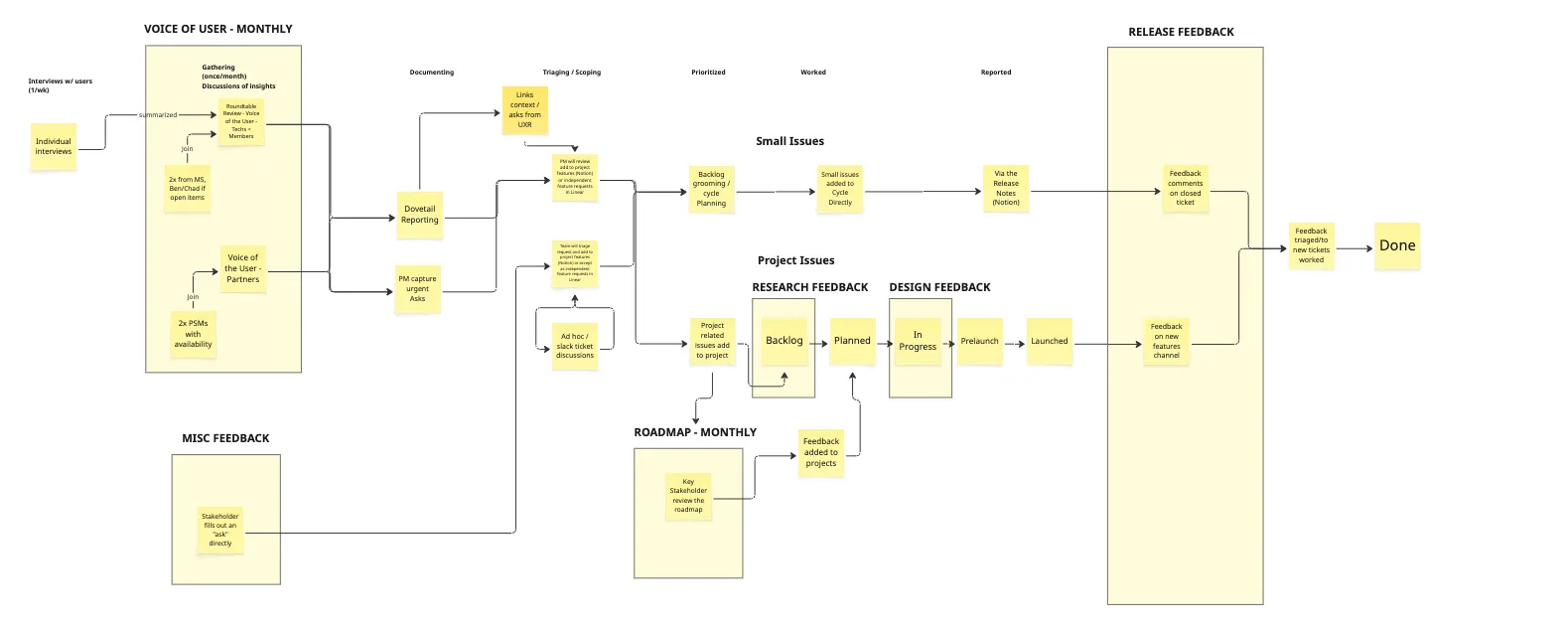
Feedback flow from interviews through triage to release
Do Some Tools Well, Not All Tools Poorly
It’s important to do some tools well based on how your market works, rather than trying to do them all—especially when you’re small.
A focused approach:
- Pick the feedback channels that match your user base
- Invest in making those channels work well
- Don’t spread yourself thin trying to monitor everything
For a B2B product with a small customer base, advisory boards and direct relationships matter more than feature voting tools. For a consumer product with millions of users, in-app feedback and surveys matter more than individual interviews.
Match your VOC system to your market.
From Noise to Signal
The User Feedback Flow
Raw feedback is noise. It’s our job is to turn it into signal.
The transformation:
| Stage | What Happens |
|---|---|
| Raw input | User feedback, interview snapshots, support tickets, survey responses |
| Documentation | Captured in research repository with context and participant info |
| Synthesis | Grouped by theme, mapped to journey stages, patterns identified |
| Opportunities | Pain points and opportunities highlighted on experience maps |
| Prioritization | Key items pulled to OST, connected to business outcomes |
| Action | Projects created, tickets written, work prioritized |
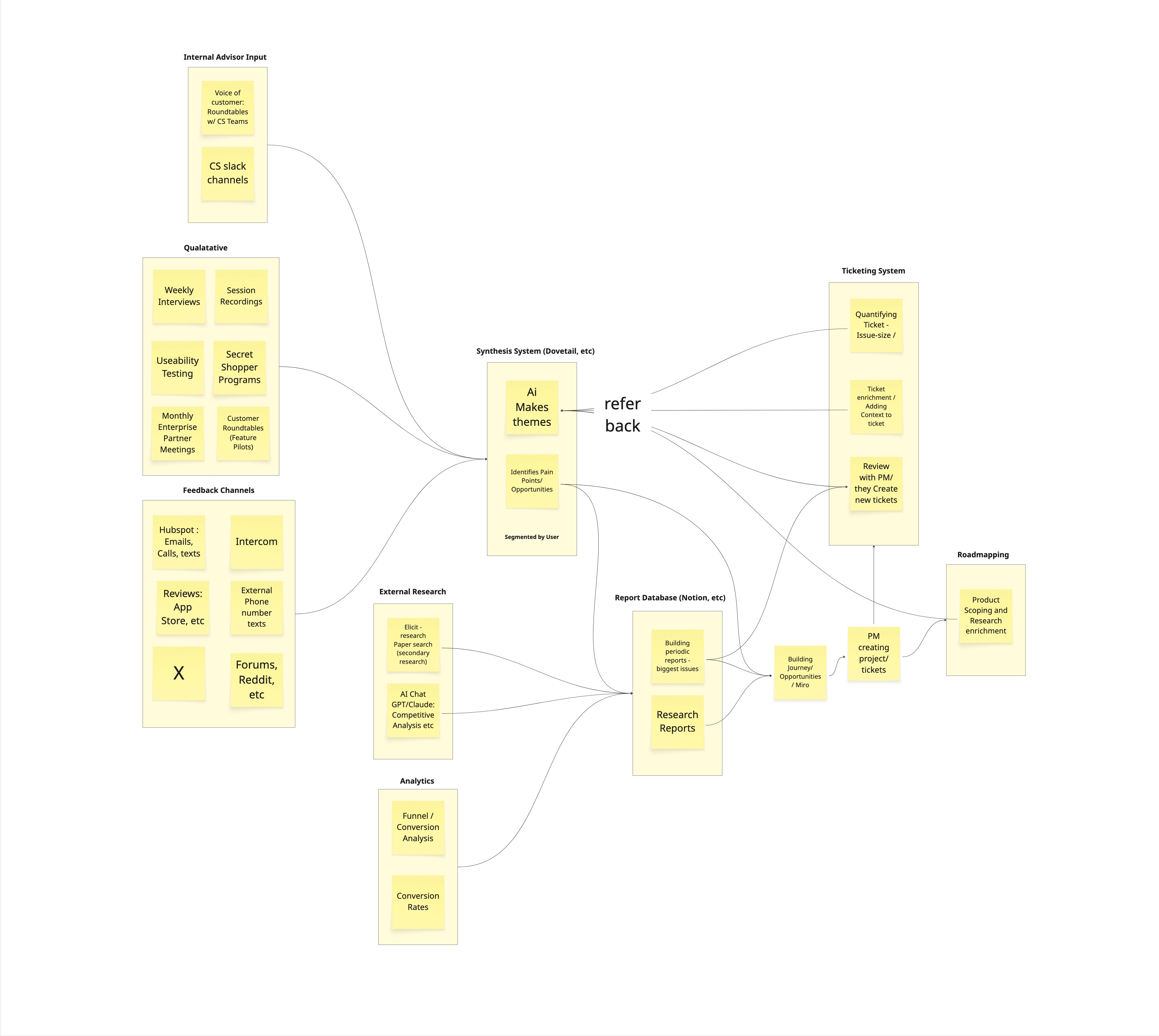
User segment feedback flowing through documentation to PM tickets
Connecting Feedback to Different Workstreams
Not all feedback becomes the same kind of work:
Small issues (quick fixes, minor improvements):
- Flow through backlog grooming → cycle planning
- Added directly to cycles when capacity allows
- Communicated via release notes
Project issues (larger initiatives):
- Added to relevant projects
- Flow through project lifecycle: Backlog → Planned → In Progress → Prelaunch → Launched
- Research and design feedback incorporated during In Progress
Roadmap-level items:
- Reviewed in monthly roadmap sessions
- Key stakeholders review and provide input
- Feedback added to project scoping
Building the Customer Model
Over time, your VOC system should produce more than individual insights—it should build a customer model.
The customer model is your accumulated understanding of:
- Who your customers are
- What problems they’re trying to solve
- What matters most to them
- How they think about your product category
- What language they use
- How their needs differ by segment
This model improves over time as you gather more feedback. It becomes the foundation for product decisions—not just individual data points, but a coherent understanding of your market.
The most valuable output a PM has is formalizing the voice of the customer. Publishing customer learnings and refining insights into a working model is critical for success and alignment across product efforts.
Summary: Voice of the Customer Principles
| Area | Core Principle | Practical Application |
|---|---|---|
| Segmentation | Understand who you’re hearing from | Track demographics, deliberately reach each audience quarterly |
| Depth vs. breadth | Do both deliberately | Advisory board for depth, fresh recruitment for breadth |
| Recruiting | Better too narrow than nothing | Start with who you can reach, expand over time |
| Methods | Match to your market | B2B: relationships and advisory boards. Consumer: surveys and forums. |
| Advisory boards | Avoid too-small influence | Cycle members, supplement with fresh perspectives |
| Quantitative | Periodic pulse checks | Spot problems, scope research focus, validate patterns |
| Feature voting | Consumer more than B2B | Only if you can maintain it actively |
| Closing the loop | Users want to know they were heard | Automate when possible, manual when it matters |
| Tool selection | Do some well, not all poorly | Focus on channels that match your user base |
| Noise to signal | Raw feedback → structured insights | Documentation → synthesis → opportunities → action |
| Customer model | Accumulated understanding | The most valuable PM output |
The Voice of the Customer isn’t about collecting feedback—it’s about building a system that transforms customer reality into product direction. The teams that do this well don’t just hear their customers; they understand them deeply enough to anticipate what they need next.